

Driving Infrastructure, Innovation, and Inclusive Growth in a Changing Global Economy
The Indian Union Budget 2026–27 presents a forward-looking and balanced roadmap aimed at sustaining economic growth while reinforcing fiscal discipline. From a global community perspective, the budget reflects India’s intent to strengthen its position as a reliable growth engine, investment destination, and strategic trade partner in an evolving international economic landscape.
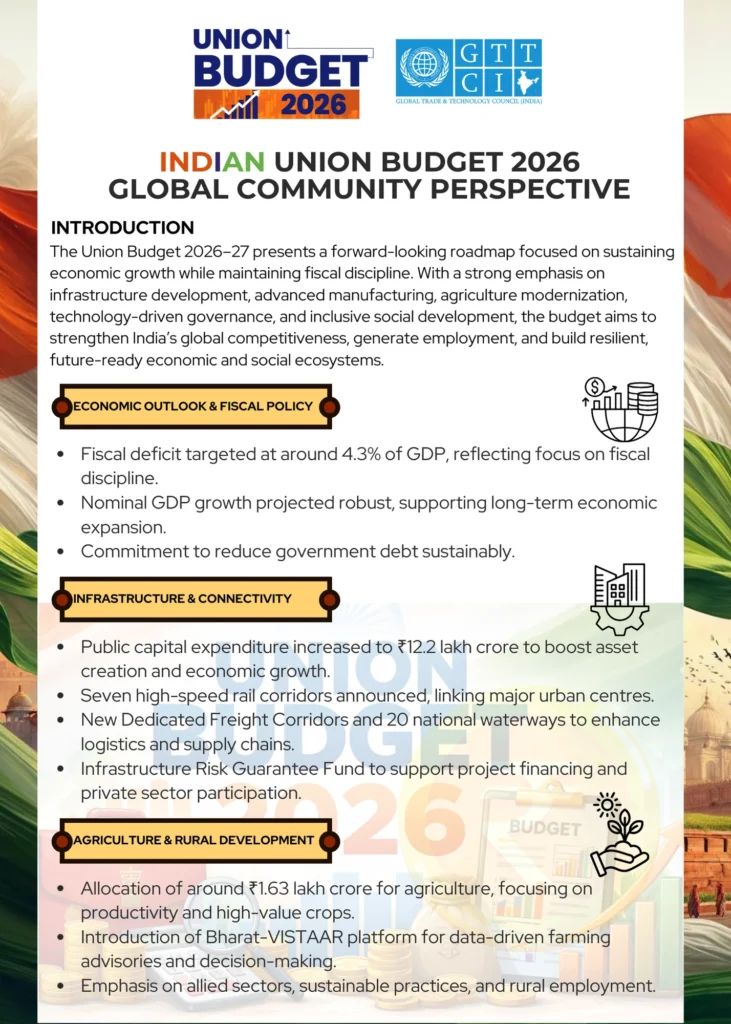
A key highlight of Budget 2026 is the strong emphasis on fiscal prudence, with the fiscal deficit targeted at around 4.3% of GDP. This approach signals policy stability, responsible governance, and long-term confidence for global investors. Supported by robust nominal GDP growth projections, the budget outlines a clear commitment to reducing government debt in a sustainable manner.
Infrastructure and Connectivity as Growth Catalysts
Public capital expenditure has been increased to ₹12.2 lakh crore, underscoring infrastructure as the backbone of economic expansion. The announcement of seven high-speed rail corridors, new Dedicated Freight Corridors, and the development of 20 national waterways is set to significantly enhance logistics efficiency, supply-chain resilience, and regional integration. The introduction of an Infrastructure Risk Guarantee Fund further encourages private sector participation and project financing.
Boosting Manufacturing, Technology, and Strategic Sectors
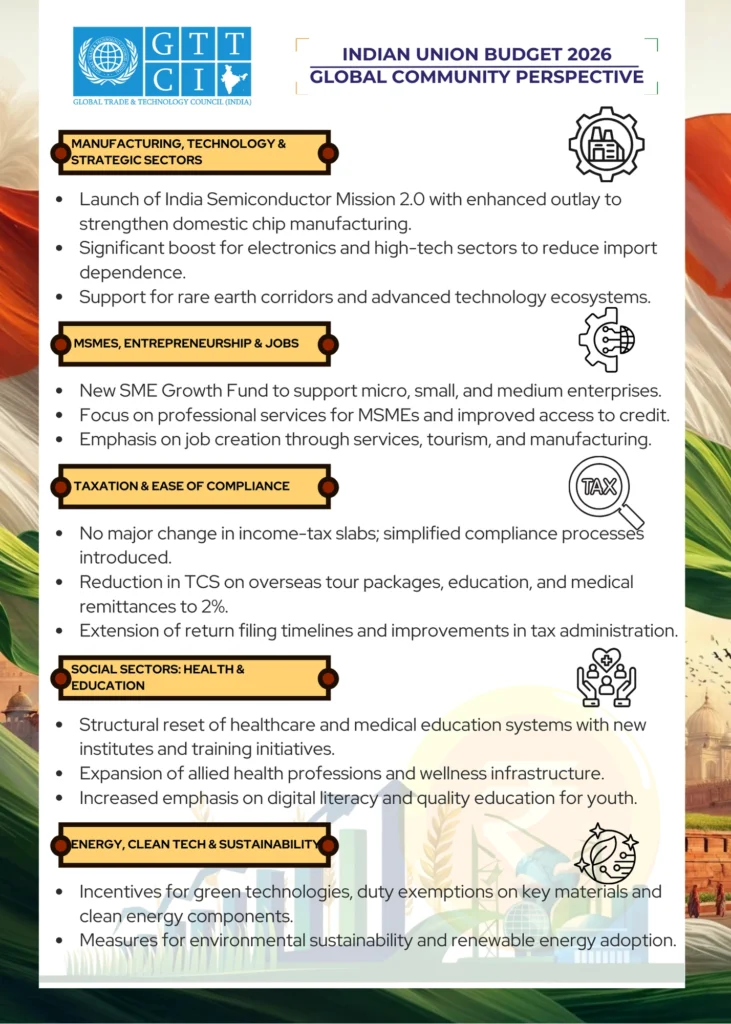
The budget places strong focus on advanced manufacturing and technological self-reliance. The launch of India Semiconductor Mission 2.0 reflects India’s ambition to strengthen domestic chip manufacturing and reduce import dependence. Additional support for electronics, high-tech industries, and rare-earth corridors positions India as a critical player in global technology and supply-chain ecosystems.
Agriculture, MSMEs, and Employment Generation
With an allocation of ₹1.63 lakh crore, agriculture and rural development remain central to inclusive growth. The introduction of the Bharat-VISTAAR platform promotes data-driven farming and productivity enhancement, while allied sectors and sustainable practices receive renewed attention.
For MSMEs, the announcement of a new SME Growth Fund, improved access to credit, and professional service support reinforces entrepreneurship and job creation across manufacturing and services.
Ease of Compliance, Social Development, and Sustainability
Budget 2026 maintains stability in income-tax slabs while simplifying compliance and reducing TCS on overseas education, medical, and travel remittances. Investments in healthcare, education, digital literacy, clean energy, and green technologies reinforce India’s commitment to inclusive development and sustainability.
Overall Takeaway
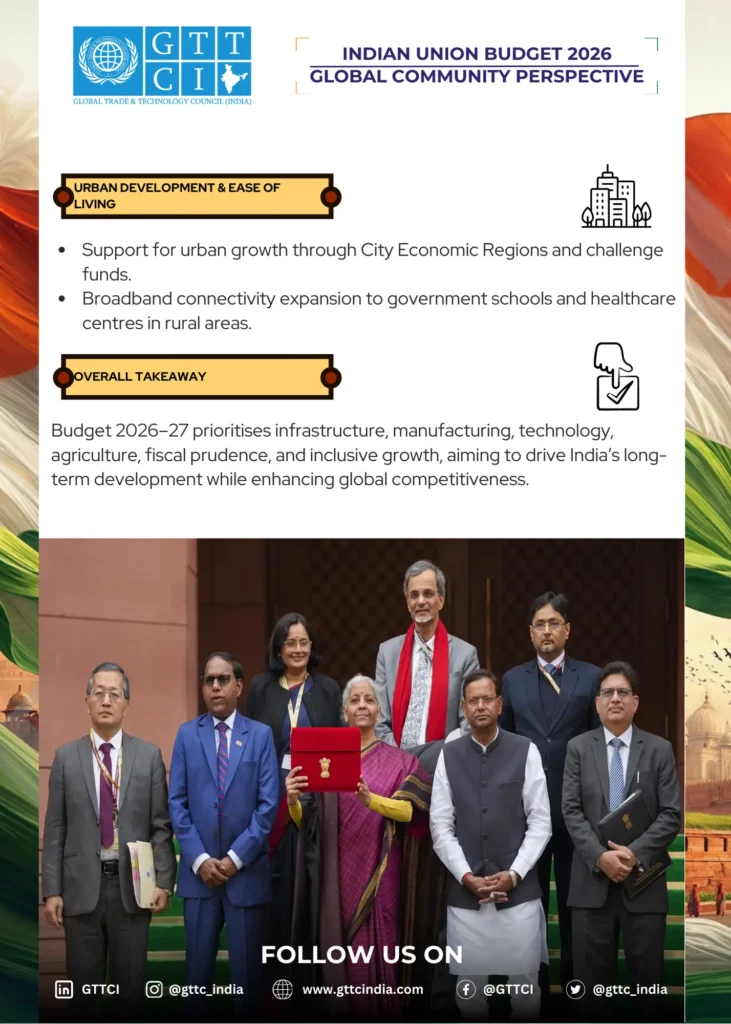
The Union Budget 2026–27 reflects a strategic balance between growth, reform, and resilience. With strong investments in infrastructure, technology, manufacturing, and human capital, the budget strengthens India’s long-term development trajectory while enhancing its global competitiveness—an outlook aligned with GTTCI’s vision of trade-driven, technology-enabled economic progress.